
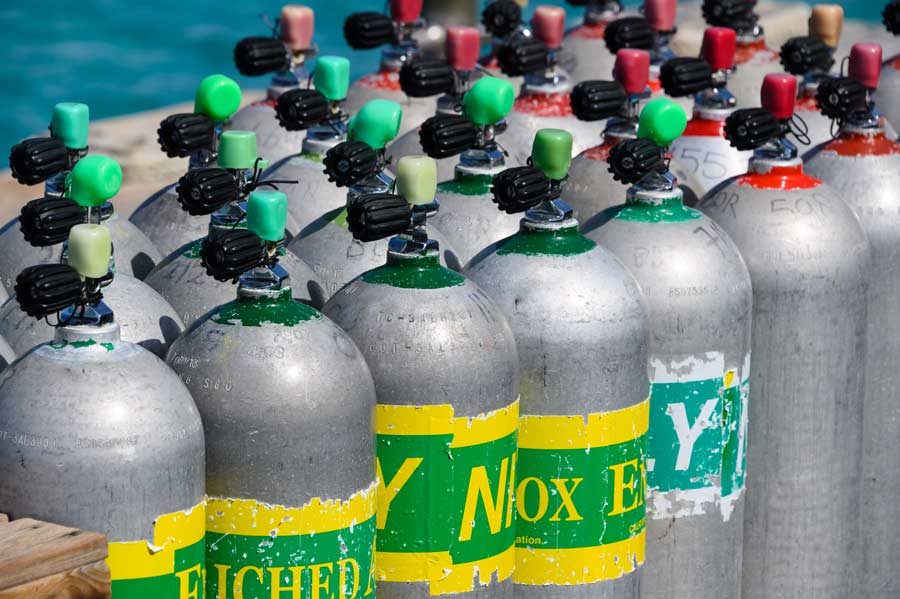
If you’ve heard divers rave that they “dive longer on Nitrox,” you’ve probably also wondered: is that marketing, or math? The short answer: math. Enriched Air Nitrox (EANx) decreases the percentage of nitrogen in your breathing gas, which increases your no-decompression limits (NDLs) and often shortens surface intervals. That’s the kernel behind the promise to “dive longer”.
Below, I break down what Nitrox is, when it helps most, what you actually learn in a Nitrox course, and the key safety guardrails to respect – so the “longer” in your dives translates into safer, better bottom time.
What is Nitrox (and how is it different from air)?
“Air” is around 21% oxygen and around 79% nitrogen. Nitrox for recreational diving bumps oxygen to common mixes like 32% (EAN32) or 36% (EAN36) – which means less nitrogen to absorb at depth. Less nitrogen uptake = longer NDLs for a given depth profile, which is why Nitrox is popular for repetitive diving days and liveaboards.
“Dive longer” explained
Nitrox doesn’t make your tank last longer or change your air consumption. Your SAC/RMV stays the same. What changes is your nitrogen loading: you can often stay at depth longer before hitting NDLs or get back in sooner between dives because you have less nitrogen to off-gas. At shallower depths where NDLs are already generous, you’ll still surface when your pressure gauge says so. Deeper recreational profiles and multi-dive days? That’s where Nitrox shines.
Where Nitrox helps the most
- Mid-depth dives (15-30 m / 50-100 ft): NDLs are often the limiting factor, so Nitrox can noticeably extend bottom time (gas supply permitting).
- Repetitive dives: Reduced nitrogen uptake on dive one means shorter surface intervals and/or longer subsequent dives within no-stop limits.
Safety guardrails you must respect
Nitrox isn’t “safer” across the board – the trade-off is oxygen toxicity risk at depth. Every mix has a maximum operating depth (MOD) based on a chosen oxygen partial pressure (commonly 1.4 bar for recreational planning). For example, EAN36 has an MOD approximately 29 m / 95 ft at 1.4 bar pO₂. You’ll learn to calculate this (or set it in your dive computer) and to analyse and label your cylinder before every dive.
What you learn in a Nitrox course
If you want an overview of a typical Nitrox Diver course – academics/knowledge, planning, and the practical steps you’ll use on real dives, check my YouTube video .
What a course is expect to cover:
- Gas theory in plain English: why less nitrogen = more NDL.
- MOD & pO₂: setting conservative limits (e.g., 1.4 bar), understanding contingency at 1.6, and why exceeding MOD is a hard no.
- EAD (Equivalent Air Depth): how tables/computers account for reduced nitrogen at depth.
- Hands-on skills: using an oxygen analyser, logging mix %, setting your dive computer to the correct blend, and labelling cylinders with mix and MOD.
- Practical application: choosing when Nitrox offers real value (multi-dive days, mid-depth sites) vs. when air is perfectly fine.
Common myths - busted quickly
- Nitrox makes my gas last longer: Nope – your breathing rate is unchanged. The benefit is NDL time, not tank endurance.
- Nitrox lets me go deeper: The opposite: higher O₂ means shallower MODs to avoid oxygen toxicity.
- Nitrox eliminates fatigue: Some divers feel better after repetitive Nitrox diving, but evidence is mixed; prioritise good profiles and conservative ascent practices either way.
Is Nitrox worth it?
For many recreational divers – yes. If you love doing two to four dives a day, explore mid-depth reefs or wrecks, and value conservative profiles with more no-stop wiggle room, Nitrox pays for itself quickly in quality of time underwater. If your diving is mostly shallow, single-tank fun dives, you might see less difference. Either way, Nitrox training is short, practical, and a great next step after Open Water.
Quick glossary
- NDL (No-Decompression Limit): Max bottom time at a given depth where you can ascend directly (with a safety stop) without required decompression.
- MOD (Maximum Operating Depth): Depth limit for a given O₂ %, beyond which pO₂ becomes too high (oxygen toxicity risk).
- EAD (Equivalent Air Depth): The “as-if on air” depth used with tables to account for reduced nitrogen in Nitrox.
Final fin-tips
- Get certified before using Nitrox; you’ll learn to analyse, label, and plan correctly.
- Always set your computer to the exact analysed mix – and double-check.
- Plan conservatively: respect MODs, keep good ascent rates, and don’t skip safety stops.
Ready to turn “dive longer” into better dive time? A Nitrox card can be one of the most useful upgrades in your logbook.