
Building on Part 1, this follow-up turns the core ideas into a practical, step-by-step workflow you can use at the fill station, on the boat, and in your dive log.
Big picture refresher: Nitrox (oxygen-enriched air) reduces the fraction of nitrogen you absorb, which can extend no-decompression limits – but it introduces oxygen exposure limits you must manage with MODs and good habits.
Your pre-dive Nitrox workflow (6 quick steps)
Analyse your gas
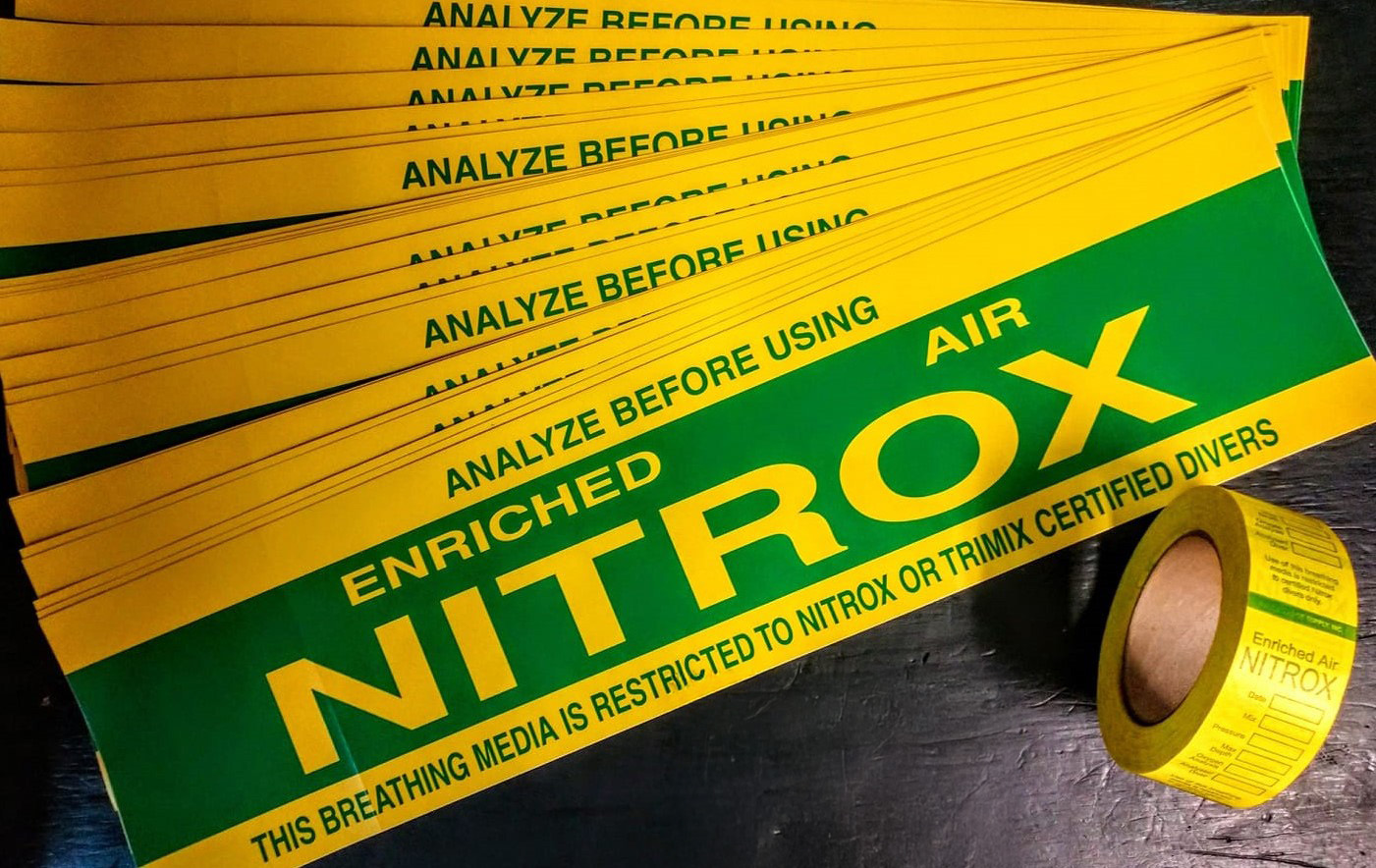
Calibrate your O2 analyser (usually to 20.9% in air), sample from the tank with a flow limiter, and let the reading stabilise. Record the exact FO2 you’ll dive. Label the cylinder with FO2 and MOD so you and your buddy can verify it at a glance.
Confirm your MOD (at pO2 1.4)
Use a conservative working limit of 1.4 bar pO2 (with 1.6 bar reserved for emergency/stop contingencies). Then set a personal buffer.
Set your dive computer
Enter your analysed FO2 and enable any pO2/MOD alerts. If computers are mixed in the team, plan for the most conservative settings.
Plan the profile
Check NDLs/EADs for your target depth so you know whether gas supply or NDL is the real limiter for the dive.
Buddy cross-checks
Swap cylinders to verify that each other’s labels and computer settings match the actual FO2.
Post-dive notes
Log FO2, MOD, pO2 settings, max depth, and any CNS% the computer reports. It makes repetitive dive planning faster and safer next time.
Worked examples (so the numbers stick)
- MOD at 1.4 pO2
- EAN32 -> ~34 m / 111 ft
- EAN36 -> ~29 m / 95 ft
These are standard recreational figures you’ll also find on PADI and other tables and charts.
- EAD at 21 m (70 ft )
- EAN32 has an EAD ~17m (56 ft) -> table NDL ~55 min (vs. air).
Oxygen exposure made simple
- Working limit: plan for 1.4 pO2;
- Contingency: 1.6 pO2 for brief stops/emergencies;
- CNS%/OTUs: let your computer track these and keep them modest on multi-dive days. The key is to never exceed MOD and to keep total exposure conservative.
Common beginner mistakes (and the fixes)
- Not analysing the tank yourself -> Always analyse, label FO2 + MOD, and sign the fill log if required.
- Forgetting to set the computer -> Make “FO2 set?” part of your pre-dive check – every dive.
- Chasing depth on rich mixes -> Higher O2 = shallower MOD. Respect it absolutely.
- Assuming Nitrox = safer in all ways -> It reduces nitrogen loading but adds oxygen-toxicity risk and fire hazards during blending/handling. Training + procedures keep you safe.
When Nitrox shines (and when it doesn’t)
- Shines: repetitive diving days in the 15–30 m / 50–100 ft band where NDLs can be the limiter. Pair with solid gas planning.
- Less impact: very shallow, single-tank fun dives where gas (not NDL) ends the dive first.
Pocket checklist
- Analyse gas -> write FO2 + MOD on tape/tag
- Set computer FO2 + pO2 alarm
- Plan to 1.4 pO2 (keep buffer)
- Confirm EAD/NDL fits gas plan
- Buddy cross-check labels & settings
- Log FO2, MOD, max depth, CNS%